In American football, having a great playbook doesn’t guarantee a great offense. As the saying that Coach Oviedo revived during the Cloob Community Offensive Clinic goes: “A playbook is just a paper unless executed with a purpose.”
A playbook is nothing more than ink on paper until the plays become intentional actions on the field. And that’s exactly where the importance of the Play Call Sheet comes in.
What is the Play Call Sheet?
The Play Call Sheet is the tool that transforms theory into quick, effective decisions. It’s the coach’s mental map – a condensed, strategic version of the playbook designed specifically for the current game. Its purpose is simple: to help you call the right play in the shortest time possible, even under pressure.
A good Play Call Sheet allows you to:
- Organize plays in a clear and logical manner.
- Access calls quickly during the game without wasting time searching through hundreds of options.
- Reduce the mental load on the coach, allowing focus on defensive reads and clock management.
- Align what’s being played with what was practiced during the week.
In essence, the Play Call Sheet is the tool that turns your weekly preparation into effective game-day execution.
Ways to organize a Play Call Sheet
There’s no perfect or universal template for designing a Play Call Sheet. The sheet must work in your favor during high-pressure moments: third downs, two-minute drills, red zone, fourth quarter… and each coach processes information differently in these scenarios.
The best format is the one that:
- Maximizes your reading speed.
- Feels intuitive to you.
- Aligns with what your team practices week after week.
Although every sheet is unique, there are several widely used organization methods:
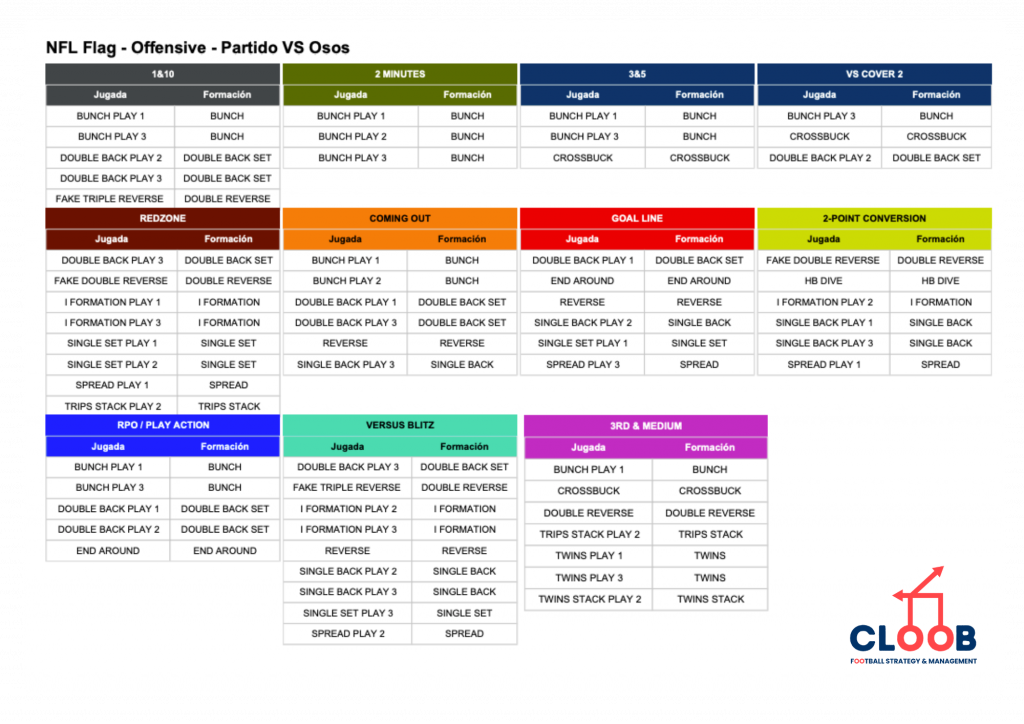
Playcalling by Field Situation
Grouping plays by down and distance helps speed up decisions in critical scenarios:
1&10, 2&short, 3&long, red zone, goal line, backed up, etc.
Playcalling by Formation
Ideal for coaches who structure their offense based on alignment: doubles, trips, empty, quads, bunch, etc. Allows quick visualization of which routes and concepts work from each look.
Playcalling by Personnel
One of the most popular methods, especially in professional offenses: 20, 11, 10, 21… Each personnel package groups available plays and makes it easier to adjust drive tempo.
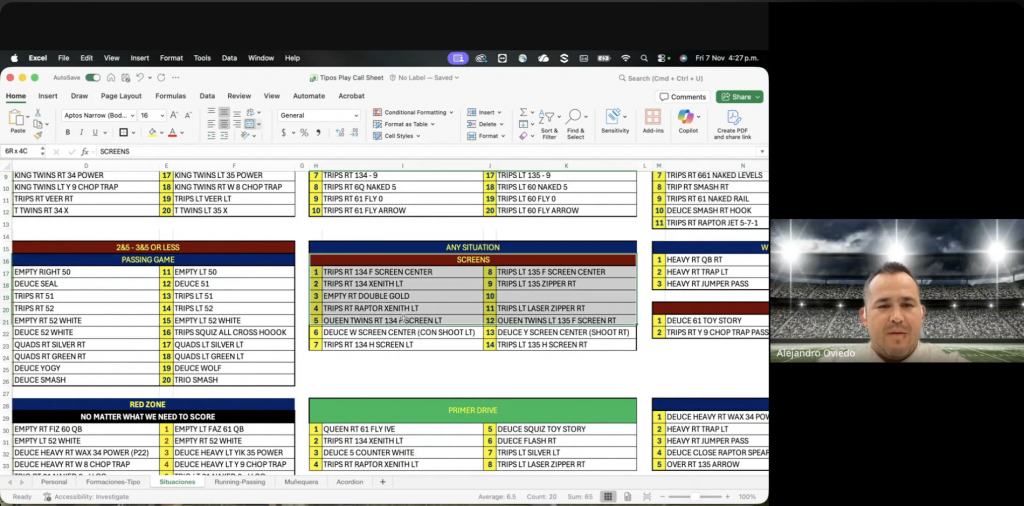
Play Call Sheet by Play Type
Divide the sheet by offensive categories: running game, passing game, trick plays, screens, RPOs, etc. Simple, visual, and useful for coaches thinking in play families.
Playcalling by Concepts
Three-step, five-step, play-action, rollouts, bootlegs, smash, flood, mesh, etc. Favors offenses based on QB progressions and reads.
Play Call Sheet by Opponent Defensive Tendencies
An advanced organization method: plays designed to attack specific fronts, coverages, pressures, or alignments identified in the game plan.
Play Call Sheet for First Drive
Many coaches start the game with a script of 8–12 pre-practiced plays. Having it clearly separated allows you to start the game with rhythm, intention, and confidence.
Rules for building a winning Play Call Sheet
A Play Call Sheet is not a decoration. It’s your battle map. The difference between reacting with hesitation or attacking with purpose. These rules separate prepared coaches from those who improvise.
1. Use only what was practiced during the week
If a play wasn’t practiced, it doesn’t exist. Many coaches make the mistake of trying to include “everything” from the playbook—this only creates overload, slow decisions, and avoidable mistakes.
Your sheet should reflect what your team can actually execute, not what you wish they could.
2. Finalize your sheet mid-week
Close your sheet between Wednesday and Thursday to practice 1–2 days with it in hand, simulate real scenarios, and adjust before the game. A tested Play Call Sheet is a reliable Play Call Sheet.
3. Clarity > Aesthetics
You’re not designing a poster; you’re building a tool for chaos. Tabs, colors, symbols, boxes… anything that helps you find the play you need in 1 second. The sheet doesn’t need to look good, it needs to be fast.
4. Highlight the most effective plays
Your sheet should guide your eye to what works best. Highlight the most effective plays so adrenaline won’t make you forget them during the game.
5. Create a sheet specific to each week
Every opponent requires a different strategy. A generic Play Call Sheet for the whole season is like trying to use the same game plan against every team, it doesn’t work. Study, adapt, and fine-tune every week. The sheet is a living weapon.
Game Plan vs Play Call Sheet
Many coaches use these terms interchangeably, but they are distinct tools with complementary functions. Understanding the difference is key to preparing your offense better. One does not replace the other; together they form the foundation of a prepared and consistent attack.
| TYPE OF DOCUMENT | Game Plan | Play Call Sheet |
| WHAT IT IS | The strategic vision that defines how and why you will attack the opponent. | The practical, condensed version of the Game Plan. It’s what you have in hand on game day. |
| QUESTIONS IT ANSWERS | What do we want to do? Why are we doing it? How will we attack this defense? What adjustments might we need based on the situation? | How will we execute the plan? What play should I call at this exact moment? |
| CONTENT | Opponent defensive tendencies analysis. Determine the best personnel to counter their fronts. Selection of base concepts targeting their weaknesses. Possible adjustments based on score, tempo, or field situation.. | Plays selected for the game. Intuitive and fast design. Clear blocks of information for the coach. |
Playcalling for Key Situations
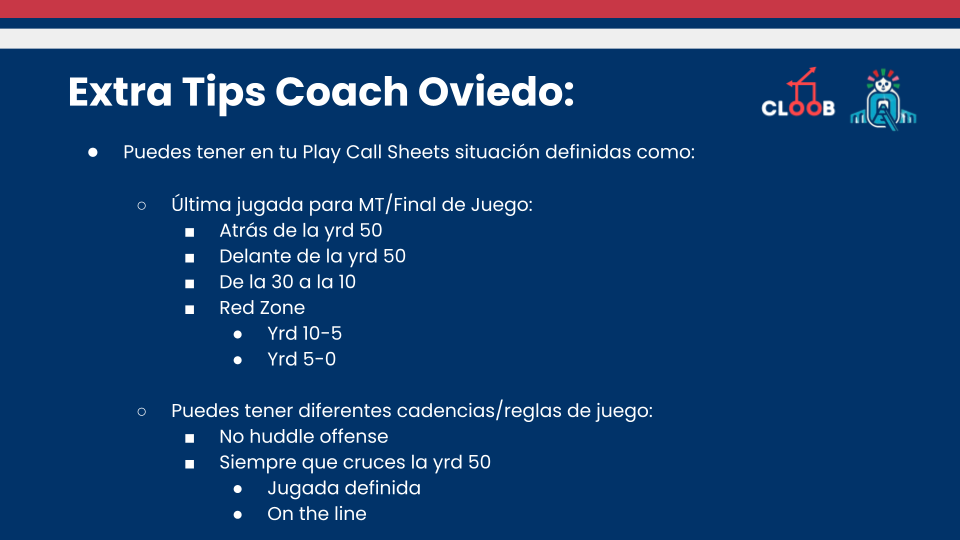
A solid Play Call Sheet anticipates critical moments. You can’t improvise when the clock is tight or when you’re backed against the wall. Include specific blocks for these situations:
2-Minute Warning
Have plays ready to:
- Advance quickly with sideline routes or plays that stop the clock.
- Call safe “shot plays” to score before halftime.
- Execute quick tempo sequences if you need to come back.
Critical Game Moments
Have clear plays for:
- 4&1 / 3&short
- Behind on your own 1–5 yard line
- Crossing the 50-yard line
- 4th down in opponent territory
- Red zone
Each scenario requires a play that you and your offense know and trust 100%.
Use Simple Rules
Simple rules reduce chaos and speed up decisions. Examples:
- “Crossing the 50, go tempo and attack vertically.”
- “On 4&1, always QB sneak or short quick game.”
- “In 2-minute situations, don’t use personnel-change plays.”
The simpler the rule, the more likely it executes well under pressure.
Automatic Plays – Golden Rules
Have one or two automatic plays per situation, so your offense can run them almost blindly.
Examples:
- 4&1 → Strong inside zone to the strong side
- 2&goal at the 3 → Quick RPO
- 3&7 → The concept most practiced that week
Mark these plays visually on your Play Call Sheet.
Mini Diagrams (Optional)
If space allows, add a small diagram for each critical play to:
- Recall alignments
- Visualize responsibilities
- Make sideline decisions faster
Build your Play Call Sheet like a PRO
Creating an effective Play Call Sheet isn’t about filling a page with plays, it’s knowing what to execute, how to execute it, and organizing it to decide in seconds.
In this blog, we covered the foundations: how to organize your sheet, rules to follow, differentiating it from the game plan, and preparing plays for critical situations. Everything a competitive staff needs to turn a playbook into points.
This content comes directly from the session with Coach Oviedo that we had the pleasure of hosting in the Cloob Community, within the Offensive Clinic of the Querétaro Staff, alongside coaches Toci and Manja.
If you want to keep improving your offense, remember that you can automate this entire playcalling process within Cloob. The platform helps you organize plays, group them by situations, formations, or concepts, and generate your own Play Call Sheet ready to print or use in games.
If you don’t have an account yet, you can try it for free and start building your system today.